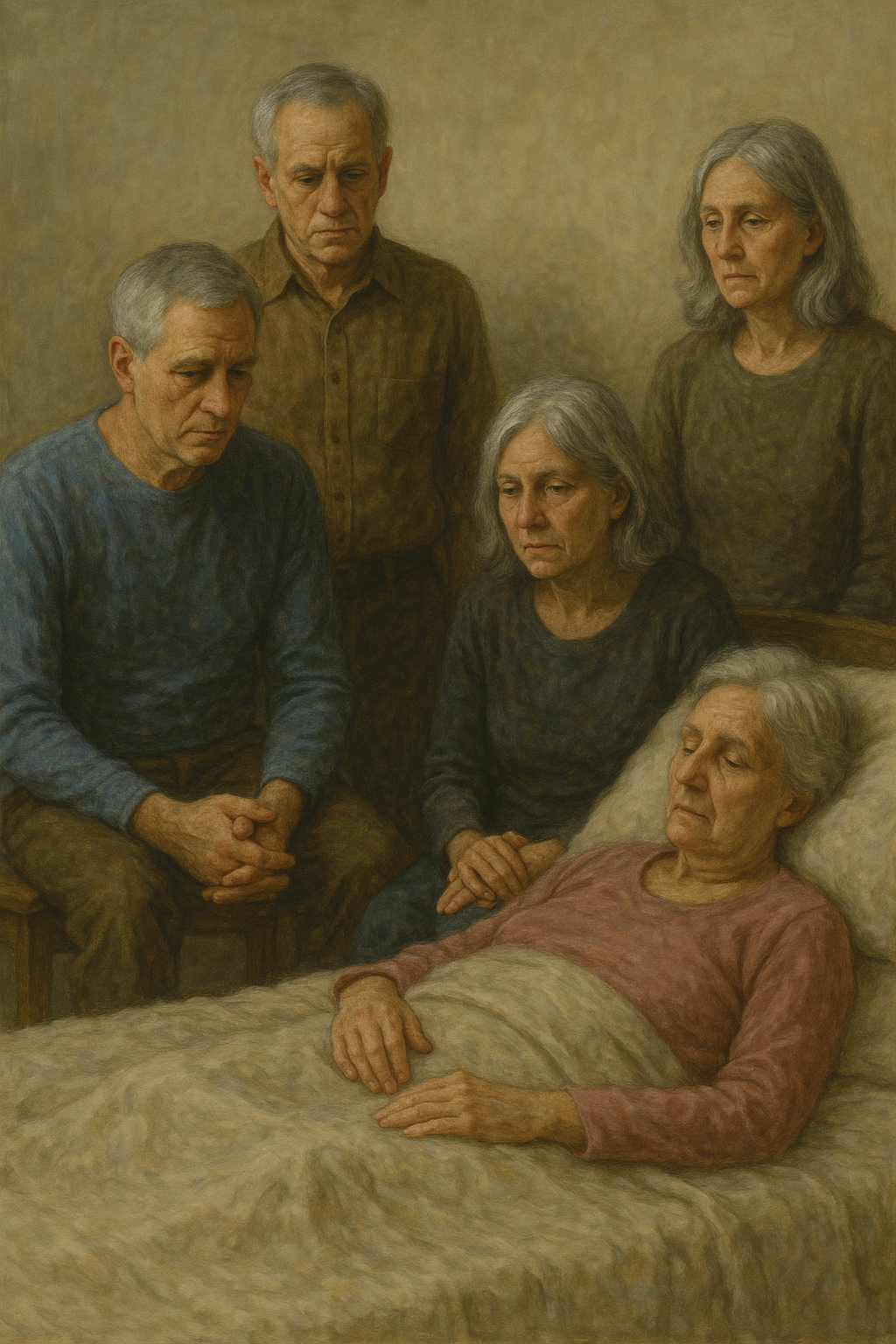
When crisis strikes a family, like the sudden and life-altering moment when my mother had a stroke, the assumption is that it will bring people closer. The idea is almost romantic: siblings rushing to each other’s sides, comforting one another, rallying around the parent who once raised them. But in my experience, that’s not what happened. My mother is now paralyzed on her left side, her life possibly forever changed. And in the face of her vulnerability, what should have been a chorus of care and collaboration among her four children has dissolved into a heavy, aching silence or an echo of single-mindedness of opinion regarding her best care.
This is the strange paradox of family. We are bound by blood, history, and memory, but that doesn’t mean we know how to communicate. We share childhoods, but not always understanding. We share DNA, but not always trust.
Some of the failure lies in old wounds, unspoken resentments, and deeply entrenched roles that we never outgrew. One sibling was always the caretaker, another the achiever, another the rebel, and another the one who kept vigilance over peacemaking. These roles don’t dissolve with time; if anything, they harden. So when Mom needed us to come together, we reverted to those old scripts. Some stepped up. Some stepped away. Some tried to control everything. Some said nothing at all.
It’s painful to admit that we, as adults, struggle to talk to one another about the most important person in our lives. It’s not that we don’t care. It’s not that we’re incapable of compassion. It’s that we’re stuck—emotionally, relationally, perhaps even spiritually. There’s fear in our silence: fear that if we speak, we’ll say the wrong thing or, worse, that we’ll express what we feel and it will shatter what little connection remains.
We fail to communicate because we don’t know how to grieve together. We don’t know how to express the helplessness of watching a parent suffer. Each of us processes that pain in our own isolated way. One dives into research about rehab options. Another disappears. One cries openly, while another makes sarcastic jokes. And the chasm widens.
In this silence, something else emerges: the ghost of unmet expectations. I thought we would come together. I thought we would take turns. I thought someone would say, “I’ve got this—go rest.” But no one says that. And so we sit in parallel grief, looking at the same mother, holding different pieces of the same heartbreak, but never saying the words that would stitch us together.
Perhaps the failure to communicate isn’t about words at all. Maybe it’s about acknowledging our shared vulnerability. To admit that we are scared. That we feel alone, even in a family of four, after Dad’s death a short five years ago.
And yet, I believe it’s not too late. The human heart is more resilient than we give it credit for. Maybe we start with a single sentence: “I don’t know what I’m doing, but I want to do this together.” Perhaps we say, “This is hard, and I miss you.”
Maybe we should stop assigning blame and start offering grace.
Our mother cannot move her left side. That loss is unspeakably hard. But perhaps the greater tragedy would be letting our silence with one another become permanent, paralyzing not only her body, but our family’s ability to heal.
We are four siblings. We can still choose to find each other: one word, one act, one olive branch at a time.



Leave a Reply